Unlocking Hidden Thermal Springs Through Extraordinary “Quantum” Mental Abilities with a 99% Success Rate

The Villafranca Case: an extraordinary documented comparison between conventional technology and exceptional “quantum” mental abilities in underground thermal water research.
In the field of deep groundwater and thermal water exploration, technology often reaches its limits.
Yet, in the Municipality of Villafranca in Lunigiana, an extraordinary case demonstrated how the human mind, when guided by rare and highly developed intuitive abilities, can identify what
conventional computer-based analysis failed to predict.
This was not simply a technical success.
It was a landmark achievement in the history of advanced water exploration.
Maurizio Armanetti, through his proprietary methodology and at present unique based on exceptional “quantum” mental abilities, identified the correct drilling point and the presence of underground thermal water where standard scientific forecasting had not succeeded.
The Comparison
Between
Maurizio Armanetti, founder of scientific dowsing, later evolved into quantum dowsing (Quantumesthesia).
Armanetti was president of Luni Ricerche srl, now ALEXANDRA sas, a world-leading company in thermal research, with a success rate certified by Italian state agencies IN THERMAL DISCOVERIES close to 99 percent.
and
Geologists: Prof. Roberto Chetoni, considered a Luminary in the Thermal field, supported by Eng. Alberto Godio (Polytechnic of Turin), Geologist Serradimigni Rino (Pisa) and electrotechnician Marchettini Sergio. The latter is the inventor of the POSEIDON experimental system, a computerized electronic detector defined by the chronicles as "electronic dowser," studied and accredited by the University of Pisa.

Although Prof. Chetoni, as he himself wrote in his final report drafted following the complete failure of the drilling operations in the Selva di Filetto (Municipality of Villafranca in Lunigiana), had stated that there are no scientific instruments capable of detecting the presence of thermal waters, he nevertheless prevented the municipality, following the preliminary success of the Armanetti thermal water pilot well, a success reported by national newspapers and weekly magazines, from carrying out the final excavation to reach the hottest thermal waters at 37–40 degrees.
The Story Behind the Historic Comparison
A Thermal Water Discovery Predicted Before Drilling
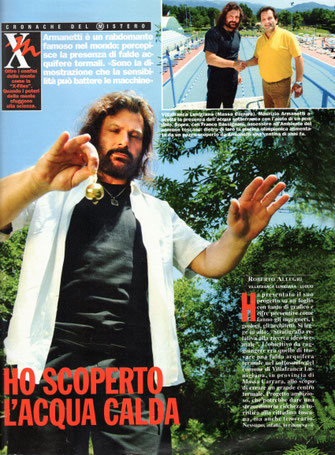
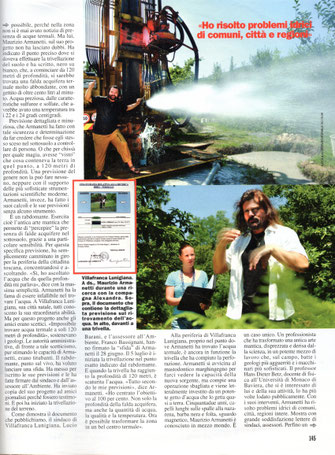
The story began when, following Maurizio Armanetti’s thermal water research, a deep well was drilled to approximately 150 meters in the Ponte Magra area of Villafranca in Lunigiana, leading to the discovery of a valuable underground thermal water source.
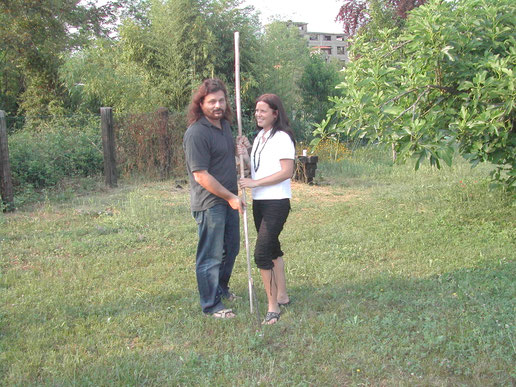
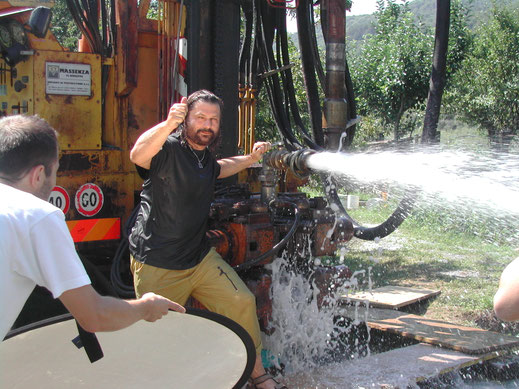
What made the event extraordinary was that the discovery had been publicly anticipated and documented to the press nearly two months before the drilling itself.
The result attracted significant national attention throughout Italy and became the subject of widespread media coverage.
Prestigious publications including Corriere della Sera and CHI reported on the remarkable discovery and the exceptional circumstances surrounding it.

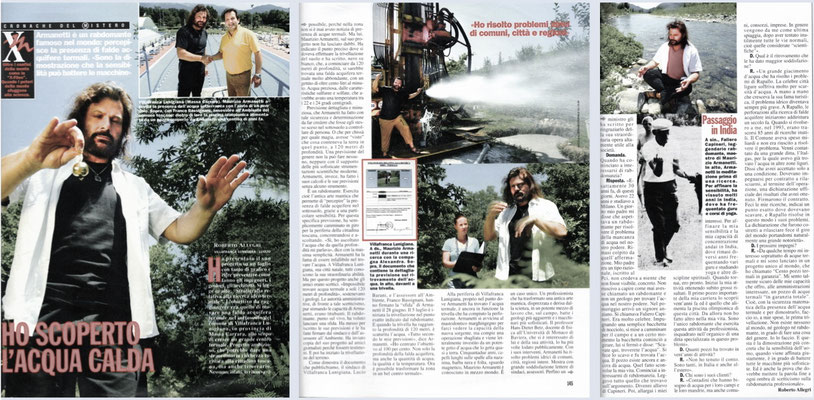
Following this remarkable success, Maurizio Armanetti identified a second strategic location in the Selva di Filetto area, with the objective of locating a high-value underground thermal water source capable of reaching temperatures of approximately 40°C for the planned Acquaparco development project.
(Despite the exceptional preliminary findings, this location was never ultimately drilled.)
Based on his research, Armanetti concluded that achieving such temperatures would require drilling to depths exceeding 550 meters.
What he could not have anticipated at the time was that this project would evolve into one of the most discussed and controversial comparisons between conventional scientific analysis and
advanced intuitive thermal water research.
Maurizio Armanetti, who, throughout his career, maintained professional relationships and collaborations with respected geologists and scientific consultants, had been officially appointed by the
Municipality of Villafranca in Lunigiana to identify a potentially valuable thermal water resource capable of supporting the international economic and wellness development of the region.
Both Armanetti and Chetoni were formally commissioned by municipal resolution to conduct the thermal water investigation. What initially began as a collaborative effort between conventional
science and advanced dowsing research gradually evolved into a direct comparison after Chetoni decided to terminate the collaboration.
Following the delivery of Armanetti’s thermal research report for the Filetto forest area, he was subsequently excluded from the continuation of the project.
The events that followed would later become one of the most debated episodes in the history of Italian thermal water exploration.
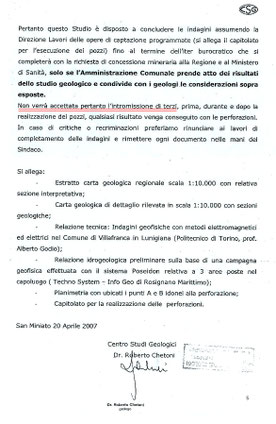
Prof. Chetoni imposed on the municipality the ouster of third parties, including Armanetti who was excluded from both the thermal research and the
Acquaparco Termale, conceived by Armanetti.
"Therefore, the meddling of third parties will not be accepted,... "
The discovery of 40°C thermal water had the potential to transform Villafranca in Lunigiana into one of Europe’s most exclusive thermal wellness destinations.
According to the development vision presented at the time, the area could have become home to Europe’s first large-scale Thermal Water Park — a landmark destination potentially capable of attracting up to one million visitors annually and generating more than a thousand new jobs.
The broader long-term vision included the development of luxury hospitality and tourism infrastructure such as golf courses, a five-star wellness resort, premium retail and shopping areas through the redevelopment of the Panda industrial zone, a high-end Beauty Farm, improved highway access, and an entirely new thermal tourism economy for the region.
However, after Maurizio Armanetti delivered his thermal research report identifying the Filetto forest area as the most promising location, Chetoni decided to remove him from further involvement in the project.
Supported by teams of engineers, geologists, and technical specialists using advanced scientific instruments and electronic surveying systems, Chetoni then attempted to identify the same thermal water stratum approximately 200 meters away from the location originally indicated by Armanetti.

Before the drilling of Chetoni’s well commenced, Maurizio Armanetti formally submitted a written statement to the municipality declaring that the location selected by Chetoni would not yield the
expected results.
In the written statement to the municipality in which Armanetti stated that no curative thermal water would be found at the spot chosen by Chetoni and that the temperature at 600 meters would be
about 28°C, instead of the expected 37 to 40°C.
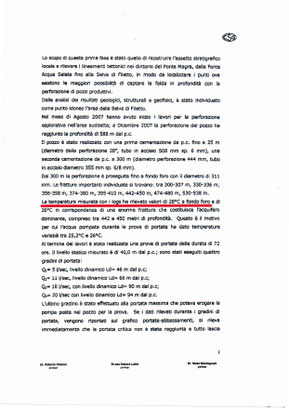
The facts proved him right (see Prof. Chetoni's report)
The drilling results ultimately confirmed Armanetti’s predictions (as documented in Prof. Chetoni’s final report), revealing temperatures significantly below those originally anticipated and
exactly 28°C how predictet by Armanetti.
Armanetti’s prediction of a 28°C water temperature proved to be 100% accurate, and his assessment that the water would not qualify as thermal water under Italian legal standards was likewise
confirmed, an extraordinary demonstration of Armanetti’s exceptional abilities.
The outcome brought an abrupt end to the ambitious development vision surrounding the project — including the proposed Thermal Aquapark, five-star wellness hotel, golf facilities, Beauty Farm,
premium shopping center, highway access infrastructure, and the broader luxury thermal tourism initiative envisioned for the region.
The unsuccessful geological exploration conducted under Chetoni’s direction ultimately compromised what could have become Europe’s first major Thermal Water Park project — an estimated €40 million investment designed to attract international tourism, stimulate the regional economy, and generate thousands of new employment opportunities.
In the aftermath of the project’s failure, much of the public criticism was directed toward Mayor Barani. Yet, according to Armanetti’s reconstruction of events, the municipality itself ultimately became the principal victim of the unsuccessful geological strategy that led to the abandonment of the original thermal vision.
The true loss extended far beyond the hundreds of thousands of euros invested in the drilling operations. What was lost, in Armanetti’s view, was the possibility of creating one of the most important thermal wellness and tourism developments in Europe — an extraordinary long-term economic opportunity capable of transforming the future of Villafranca in Lunigiana for generations.
At the time, Armanetti attempted repeatedly to alert and involve the local population through public statements, informational leaflets, and newspaper articles, hoping to obtain the support necessary to preserve the original project and prevent its collapse.
However, the warnings went largely unheard, and the opportunity gradually disappeared amid public indifference and institutional divisions.
Today, many observers continue to reflect on what Villafranca might have become had the thermal project succeeded as originally envisioned: a prestigious international wellness destination capable of attracting investment, tourism, employment, and long-term prosperity to the entire region.
What once appeared to be the beginning of a historic transformation ultimately became, for many, the story of a remarkable opportunity lost.
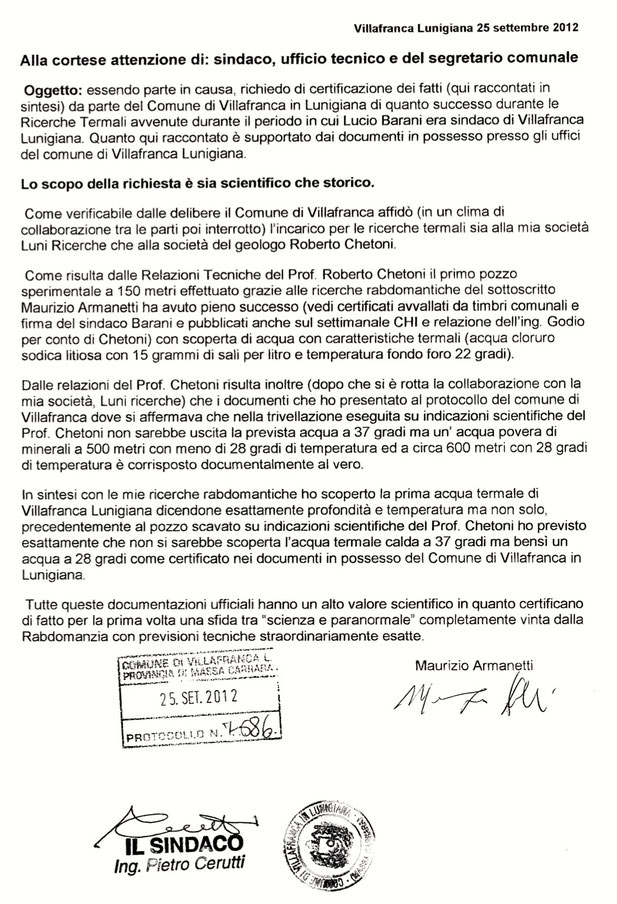
Final Official Summary of the Events
Based on Official Documents Certified and Stamped by the Municipality of Villafranca in Lunigiana and Formally Signed by the Mayor
Press review
CORRIERE DELLA SERA
Corriere della Sera is one of Italy’s oldest, most prestigious, and widely read national newspapers. Founded in Milan in 1876, it is often
considered the Italian equivalent of major international newspapers such as The New York Times or The Wall Street Journal in terms of historical influence, national relevance, and institutional
credibility.
It covers politics, economics, culture, science, and major national and international events, and its articles are frequently cited by television networks, institutions, and academic sources
throughout Italy. Being featured or mentioned in Corriere della Sera is generally regarded in Italy as a significant form of mainstream national recognition.

CHI
Chi is one of Italy’s best-known celebrity and entertainment magazines. It focuses on public figures, television personalities, actors, fashion, lifestyle, and high-profile social
events.
For an American audience, it can be compared to magazines such as People, Us Weekly, or Hello! in the UK. It is widely recognized in Italy for covering celebrities, exclusive interviews, social trends, and
popular culture rather than politics or hard news.
Being featured in Chi generally reflects mainstream public visibility and media popularity within Italian entertainment and social culture.